How to Price Your Books for Profit — Not Just Sales
Sales screenshots feel good. Rankings feel validating. But neither of those things pays your editor, covers your marketing spend, or keeps your author business sustainable long term.
Profit does.
One of the biggest mindset shifts indie authors have to make is separating visibility from viability. A book can sell hundreds—or even thousands—of copies and still lose money if pricing decisions aren’t grounded in reality. And “because everyone else prices it that way” is not a pricing strategy.
If you want your publishing career to last, pricing has to move out of the emotional column and firmly into the business column.
Sales, Revenue, and Profit Are Not the Same Thing
These three terms are often used interchangeably in publishing conversations, but they describe very different things—and confusing them leads to poor decisions.
Sales describe volume: how many copies you sell. Revenue describes cash flow: how much money comes in. Profit is what remains after you subtract every cost associated with creating, publishing, and selling the book.
A book can perform well in sales and still be unprofitable. This usually happens when authors underprice out of fear, rely heavily on discounts, or never fully account for what the book actually cost to produce.
Why “Low Price = Safe Choice” Is a Myth
Many authors default to low pricing because it feels safer. They worry that higher prices will scare readers away or that they won’t be competitive in a crowded marketplace.
But low prices don’t remove risk—they shift it. When margins shrink, you’re forced to rely on higher sales volume just to break even. Volume is unpredictable, algorithm‑dependent, and exhausting to chase.
Pricing also sends a signal. When a book is consistently priced far below genre norms, readers may associate it with lower value—even if the content is strong.
You Can’t Price Strategically Without Knowing Your Investment
Before deciding whether your ebook should be $3.99 or $6.99—or whether your paperback should be $14.99 or $20.99—you need to know what you put into it.
That includes editing at all stages, cover design, illustrations, interior formatting for print and ebook, ISBNs, publishing fees, marketing spend, software subscriptions, and any assets purchased to support the book.
These are not optional or abstract expenses. They are the foundation of your book as a product. Until you total them up, pricing decisions are educated guesses at best.
Why Most Pricing Advice Overcomplicates the Problem
A lot of pricing advice dives immediately into platform‑specific royalty charts, delivery fees, discount percentages, and constantly changing algorithms. That level of detail has its place—but not at the decision‑making stage.
What authors need first is clarity. You need to see how your total investment, your price points, and your realistic sales estimates interact. Without that visibility, pricing becomes reactive instead of strategic.
Use a Calculator to Think, Not to Stress
This is where a simple pricing calculator becomes valuable—not as an accounting tool, but as a planning framework. When you can see your publishing costs alongside estimated sales across formats, pricing decisions stop being emotional and start being intentional.
Download Your Own Copy
This pricing calculator opens in Google Sheets. To use it, make a copy to your own Drive and enter your numbers in the light grey cells.
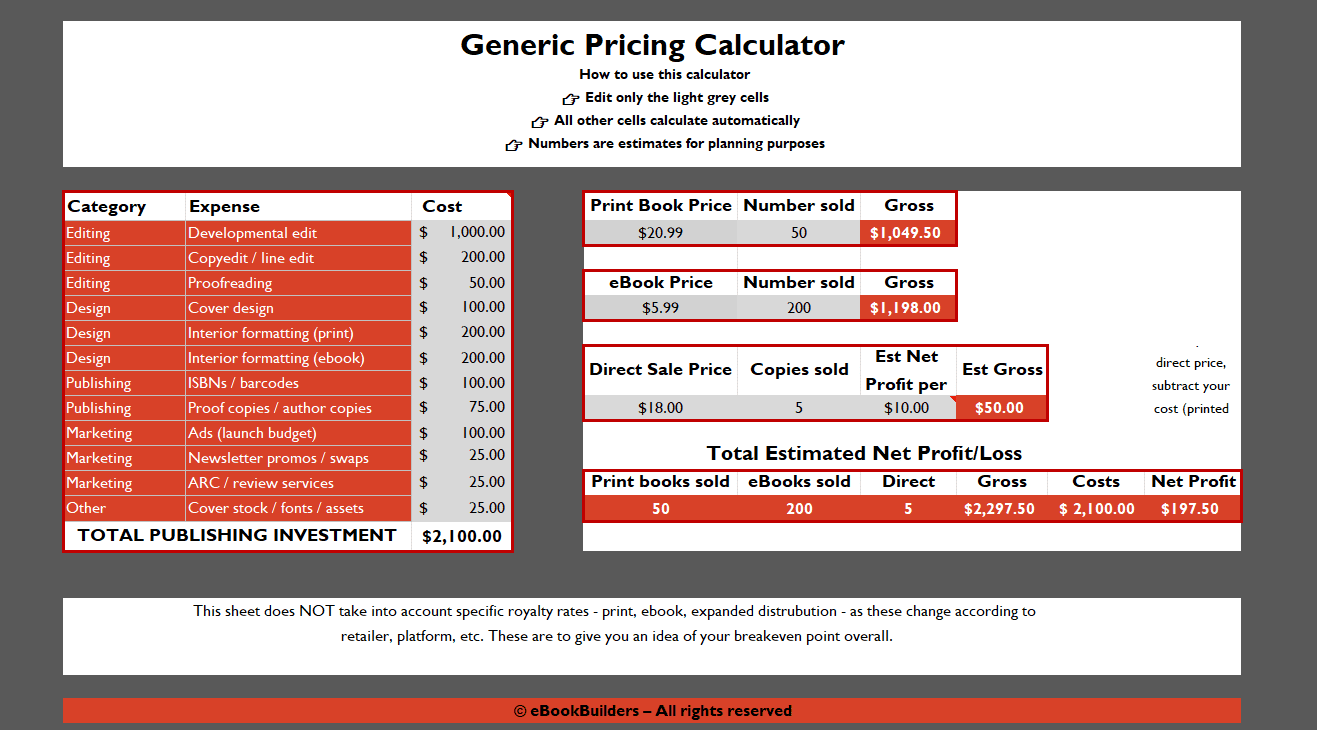
This calculator opens in Google Sheets. Make a copy to your own Drive to test pricing scenarios using your real numbers.
What This Calculator Is (and Isn’t)
This calculator is designed for planning and education. It helps authors understand their overall publishing investment, compare print, ebook, and direct sales at a high level, and evaluate pricing choices.
It is not intended to replace platform reports, royalty dashboards, bookkeeping software, or tax preparation. The goal is not perfect math—the goal is better decisions.
Why Direct Sales Deserve Attention
One of the most eye‑opening outcomes when authors use pricing tools like this is realizing how powerful direct sales can be. Selling fewer books at a higher net return—through a website or in‑person events—can often generate more profit than relying solely on retailer volume.
That doesn’t mean abandoning major platforms. It means understanding where control, margins, and flexibility live within your business.
Pricing Is a Long‑Term Business Decision
Smart pricing supports sustainability. It allows you to reinvest in quality, market without panic, use discounts strategically, and avoid burnout from chasing volume.
Your price does not need to be perfect. It needs to be informed.
Final Thought (No Panic Required)
You don’t need to be an accountant to price your books responsibly. You need visibility, context, and the willingness to treat your work like the business asset it is.
When pricing decisions are grounded in reality instead of fear, you stop chasing sales and start building something sustainable.



Recent Comments