Royalties vs. Revenue: What Authors Are Actually Earning
Royalties vs. Revenue: Understanding Your True Earnings
If there’s one place authors consistently misread their own success, it’s here.
Not because they’re careless. Not because they don’t care about money. But because the publishing world throws around numbers in a way that makes everything look bigger, shinier, and more impressive than it actually is.
You open your dashboard, you see sales coming in, you see royalty payments hitting your account, and it feels like things are working. And sometimes they are. But without context, those numbers can be incredibly misleading.
Because what most authors are looking at isn’t profit. It isn’t even true earnings.
It’s activity.
And activity is not the same thing as a sustainable business.
Revenue Looks Impressive—But It’s Only the Starting Point
Revenue is the number authors love to share. It’s the easiest one to point to, and it sounds the most impressive.
“I made $5,000 from my book.”
“My launch brought in $2,000 in a week.”
Those numbers feel like momentum. They feel like validation. But revenue is just the top line—the total amount of money that came in before anything is taken out.
It doesn’t account for what you spent to get there. It doesn’t reflect your margins. And it certainly doesn’t tell you whether your book is actually profitable.
Revenue tells you how much money passed through your hands. It does not tell you how much you kept.
Royalties Feel More Real—But They’re Still Not the Full Story
Most authors eventually shift from looking at revenue to looking at royalties, which is a step in the right direction.
Royalties are what platforms actually pay you after their cut. Whether it’s Amazon, IngramSpark, or Draft2Digital, that number already reflects things like distribution percentages, print costs, and delivery fees.
So yes, royalties are closer to reality.
But they’re still incomplete.
Because royalties don’t account for everything that happened before the sale.
They don’t include your editing costs. They don’t include your cover design. They don’t include your ad spend, your formatting, your software, or the time and money you invested into making the book exist in the first place.
And that missing piece is where most authors lose the plot.
The Part Most Authors Avoid: Expenses
This is where things get uncomfortable—and where clarity actually starts.
Most authors know how many books they’ve sold. They know what their royalty rate is. But if you ask them what the book cost them to produce, you’ll either get a rough guess or a very long pause.
That’s not a judgment. It’s just reality.
But here’s the problem: without knowing your total investment, you can’t measure success accurately.
Let’s say your book generates $3,000 in royalties over a few months. That sounds like a win. And in some cases, it is. But now subtract:
- professional editing
- cover design
- formatting
- ads and promotions
- any tools or subscriptions you used
Suddenly, that $3,000 looks very different. It may still be profitable—but it’s not what you thought it was. And if you don’t understand that gap, you’ll make your next decisions based on the wrong numbers.
Why This Confusion Leads to Bad Decisions
This isn’t just about semantics. It directly impacts how authors run their businesses.
When revenue or royalties are mistaken for profit, authors tend to:
- price too low because they think they’re “doing fine”
- increase ad spend without understanding their margins
- double down on strategies that aren’t actually profitable
- chase volume instead of sustainability
On the surface, everything looks like it’s working. Behind the scenes, the math tells a very different story.
And the longer that disconnect goes unchecked, the harder it becomes to course-correct.
The Trap of a “Good Month”
One of the most common patterns I see is what I call the “good month trap.”
Sales spike. Royalties increase. The dashboard looks healthy. And the immediate reaction is to scale—more ads, more promotions, more effort.
But without context, that “good month” might not be what it appears.
It could be:
- barely profitable
- break-even
- or even operating at a loss once expenses are factored in
Without a clear understanding of what’s actually being earned, growth decisions become reactive instead of strategic.
And that’s where authors start working harder while earning less.
You Don’t Need Complex Systems—You Need Clear Visibility
This is where a lot of authors shut down. They assume that understanding their numbers requires complicated spreadsheets, advanced accounting knowledge, or hours of tracking.
It doesn’t.
You don’t need perfection. You need visibility.
You need to be able to answer three simple questions:
- What did this book cost me to produce?
- What am I earning per sale?
- What is actually left after everything is paid?
That’s it.
When you can answer those questions consistently, everything else becomes easier—pricing, marketing decisions, even long-term planning.
Where This Becomes Real (Not Just Theory)
Understanding the difference between revenue, royalties, and profit is important. But on its own, it’s still abstract.
This is where most authors get stuck.
They understand the concept. They nod along. And then they go right back to making pricing and marketing decisions based on whatever number looks best on their dashboard.
Because without a way to see how the numbers work together, it stays theoretical.
If you haven’t already, go read:
How to Price Your Books
for Profit — Not Just Sales
That post walks through this in a practical way and includes a pricing calculator you can use to test your own numbers.
Not hypotheticals. Not industry averages. Your actual costs, your pricing, and your realistic sales expectations.
What most authors discover when they use it is this:
A book that looks successful based on sales or royalties can be barely breaking even—or worse, losing money.
And on the flip side, a book that isn’t selling in massive volume can still be quietly profitable because the pricing and margins make sense.
That’s the shift.
Once you can see the full picture, you stop reacting to numbers and start making decisions based on them.
If you want to take this out of theory and into something practical:
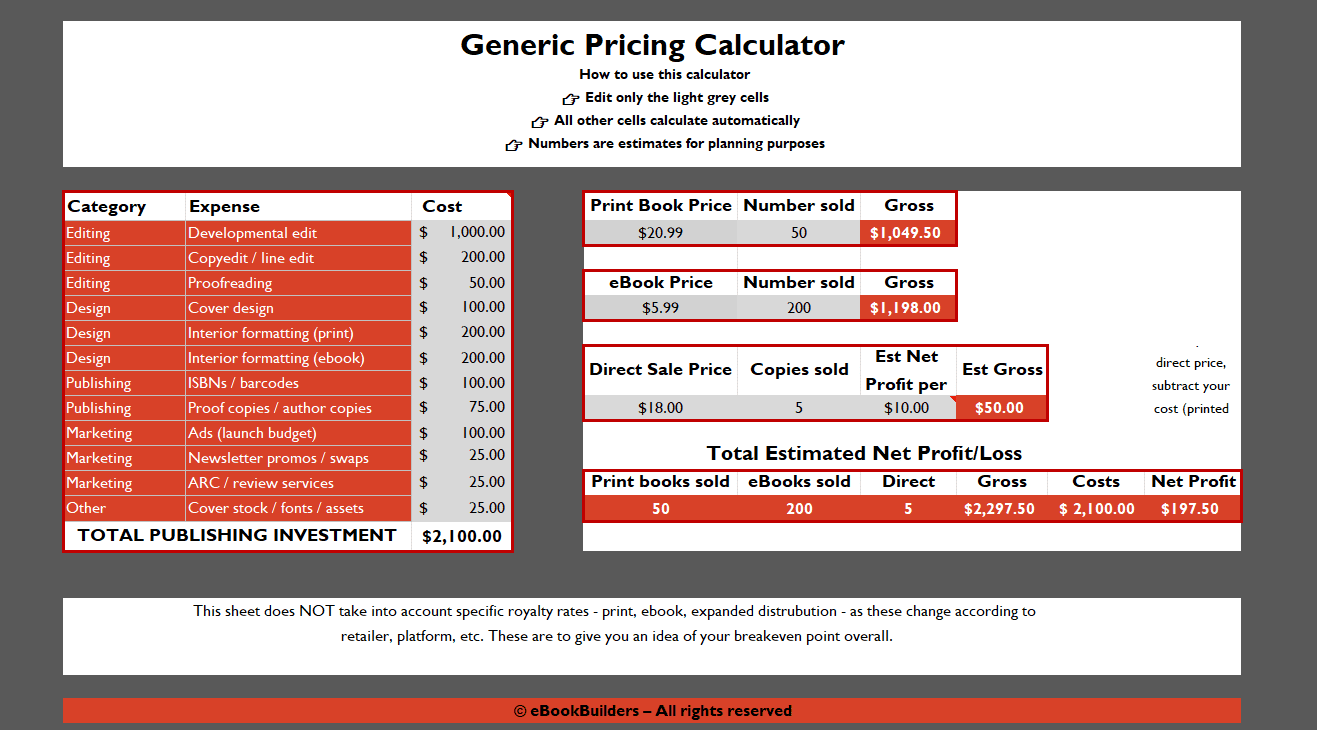
Use the pricing calculator from the previous post to test your costs, pricing, and estimated sales in real time.
Open it in Google Sheets, make a copy, and plug in your own numbers. It takes five minutes—and it will change how you look at your book’s performance.
This Is the Line Between Writing Books and Running a Business
There’s a clear difference between authors who write books and authors who build sustainable publishing careers.
It doesn’t come down to talent. It doesn’t come down to luck.
It comes down to awareness.
Hobbyist thinking focuses on output and sales:
“I sold a lot of books.”
Professional thinking focuses on sustainability:
“Was it profitable, and can I repeat it?”
That second question is what turns publishing into a business instead of a cycle of effort and hope.
The Hard Truth
Revenue is what you make on paper.
Royalties are what platforms pay you.
Profit is what you actually keep.
If you’re not tracking all three—and understanding how they connect—you’re making decisions without the full picture.
And in an industry where margins matter, that’s not a small oversight.
Clarity doesn’t complicate your process. It strengthens it.
Because once you understand your true earnings, you stop guessing. You stop reacting. And you start building a publishing business that can actually support you long term.




Recent Comments